


Posts tagged with "Surgical Planning"
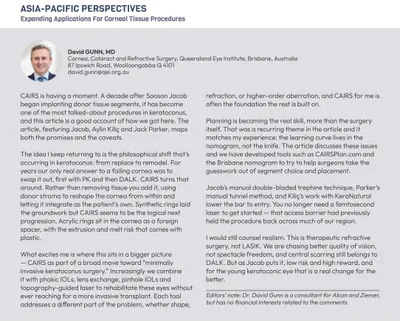
Dr David Gunn in EyeWorld Asia-Pacific: CAIRS and the Move From Replacing the Cornea to Remodelling It
Published on 15 Nov 2026
EyeWorld Asia-Pacific invited Dr David Gunn to write the regional commentary on CAIRS and corneal tissue procedures for keratoconus in its September 2026 issue. The full commentary is shown here, with an explanation of each point for patients.
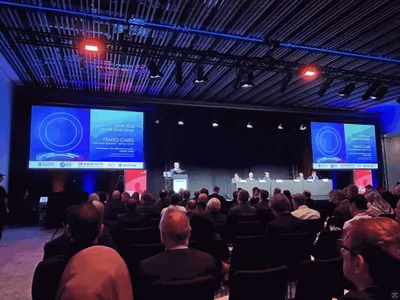
Dr David Gunn at ESCRS 2026: Four CAIRS Talks in London
Published on 28 Sept 2026
What Dr David Gunn presented on CAIRS at ESCRS 2026 in London: two course talks, the Ziemer symposium, now on YouTube, and the LWVI wet labs.
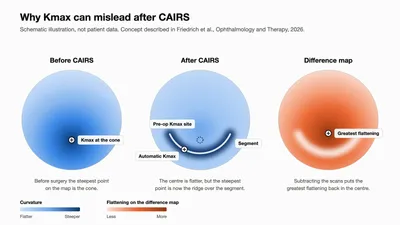
Why Kmax Can Mislead After CAIRS: A Commentary in Ophthalmology and Therapy
Published on 10 Sept 2026
Dr David Gunn co-authored a 2026 commentary illustrating in two eyes how Kmax can rise after CAIRS despite central flattening. The authors propose additional measurements; these have not been validated as progression markers.
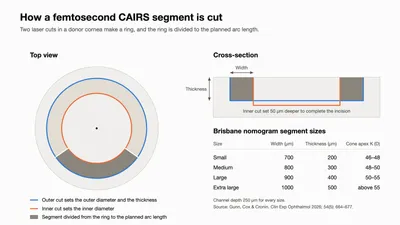
Femtosecond CAIRS in 85 Eyes: The Brisbane Study and the Donor Tissue Question
Last Updated: 10 Sept 2026
Dr David Gunn's femtosecond CAIRS study in Clinical & Experimental Ophthalmology drew a published letter on donor tissue and patient selection. The 85-eye series reported improved vision; the reply explains tissue use and the choice of patients.
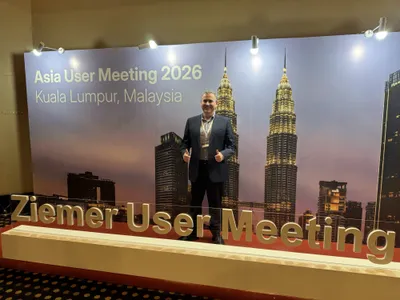
Femto CAIRS at the Ziemer Asian User Meeting 2026, Kuala Lumpur
Published on 2 Apr 2026
Dr David Gunn presented Femto CAIRS in the therapeutics session at the Ziemer Asian User Meeting in Kuala Lumpur, walking surgeons through how a CAIRS plan is built from the corneal map.
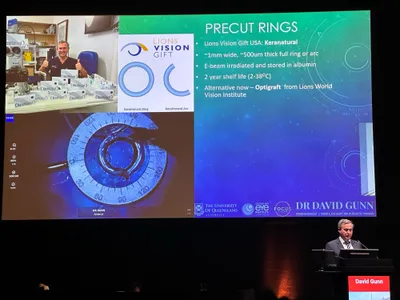
Transitioning to CAIRS: Precut Rings and the Brisbane Nomogram at ESCRS Copenhagen 2025
Published on 23 Sept 2025
Dr David Gunn joined the Transitioning to CAIRS session at the 43rd ESCRS Congress in Copenhagen, presenting precut allogenic ring segments, the 2025 Brisbane nomogram and the CAIRSPlan planning platform.
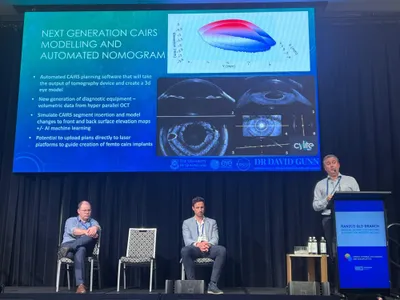
Next Generation CAIRS Modelling and Automated Nomograms: RANZCO Queensland 2025
Published on 28 Aug 2025
Dr David Gunn presented automated CAIRS planning built from hyper-parallel OCT data at the RANZCO Queensland Branch Annual Scientific Meeting on the Gold Coast, and took the cornea controversies session.