


Low Recurrence
Covering the area with a conjunctival autograft greatly reduces the chance of the pterygium coming back, compared with older surgery that left the eye bare.
Dr Gunn's standard technique is a modern 'no-stitch' pterygium removal that secures the graft with tissue glue instead of sutures — for a much more comfortable recovery — performed by a fellowship-trained corneal specialist.
A pterygium (often called "Surfer's Eye") is a non-cancerous, fleshy growth that develops on the white of the eye (the conjunctiva) and can grow onto the clear central window of the eye (the cornea). While they are benign, they can become inflamed, unsightly, and—if left untreated—can permanently distort your vision.
Queensland has one of the highest rates of pterygium in Australia due to intense UV exposure. Pterygium affects up to 7% of Queenslanders, particularly those who spend time outdoors.
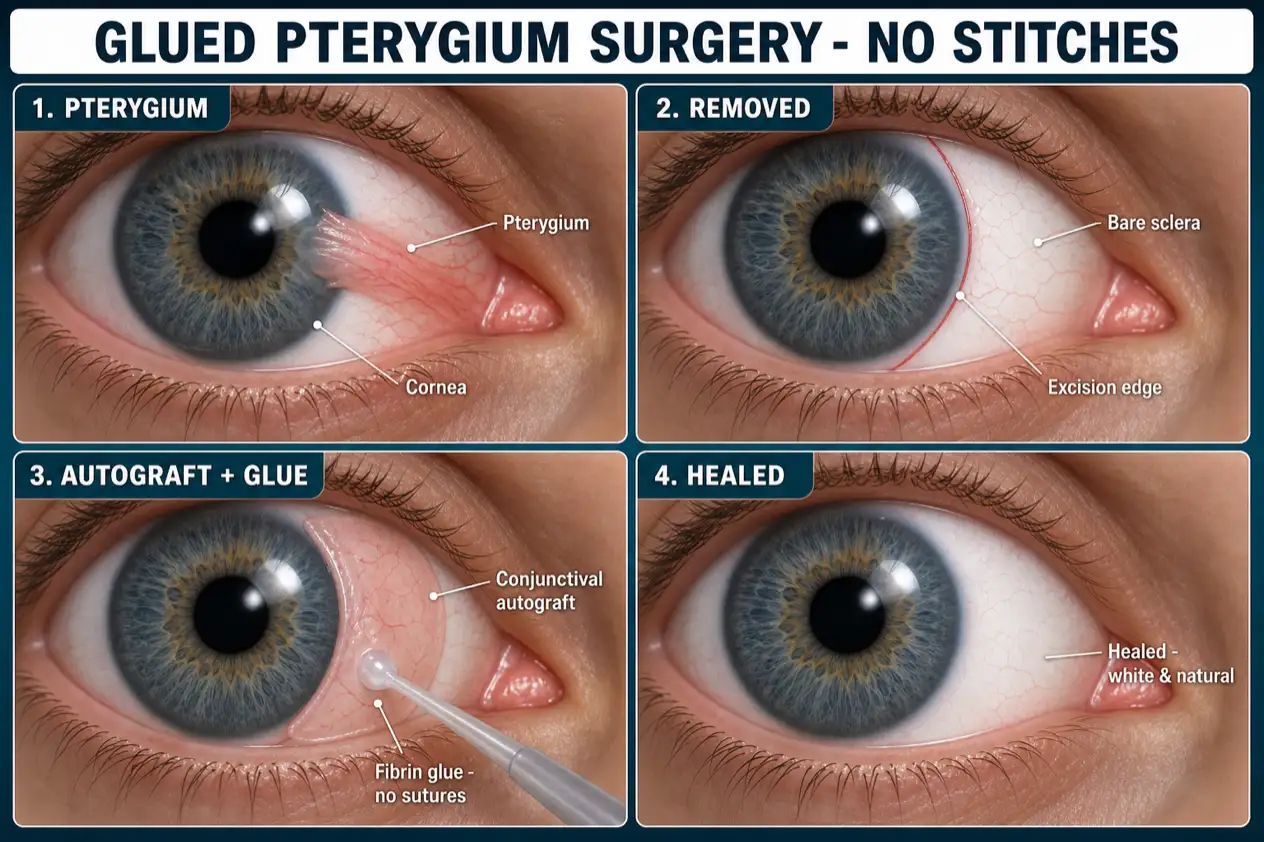
Traditional pterygium surgery secures the graft with sutures (stitches), which can feel scratchy while they dissolve. Dr Gunn instead uses a sutureless technique, holding the graft in place with tissue glue.
As a fellowship-trained corneal specialist, Dr Gunn removes the pterygium and covers the area with a conjunctival autograft — most often secured with tissue glue rather than stitches — an approach chosen to reduce discomfort and keep the recurrence rate low.
After removing the pterygium, Dr. Gunn transplants a small, healthy piece of your own tissue to the site. This acts as a barrier to prevent the growth from coming back.
Instead of stitches, we use a biological 'glue' (fibrin sealant) to secure the graft. This leaves a smoother eye surface and a more comfortable recovery than stitches, with nothing to remove afterwards.
Dr Gunn performs a meticulous removal of the underlying 'Tenon's' tissue — thorough removal is one of the most important factors in keeping recurrence rates low.
Covering the area with a conjunctival autograft greatly reduces the chance of the pterygium coming back, compared with older surgery that left the eye bare.
The aim is a clear, comfortable eye with a natural appearance once healing is complete.
Surgery is performed under heavy twilight sedation, so you sleep comfortably through the procedure.
"Pterygium surgery is a delicate surface procedure. As a corneal specialist, Dr David Gunn focuses on a thorough removal and a well-positioned graft — the details that help achieve a smooth result with a low chance of recurrence."
RANZCO Gold Medalist & first surgeon in Australia to perform CAIRS (2021)
Fellowship-Trained Corneal & Refractive Surgeon
A 45-minute assessment where Dr. Gunn will measure the size and activity of the pterygium using high-resolution photography to determine if surgery is necessary.
HIGH-RESOLUTION PHOTOGRAPHY
A day-hospital procedure taking 20–30 minutes per eye, performed under a high-powered surgical microscope with heavy twilight sedation, so you sleep through the procedure.
MICROSURGICAL APPROACH
Most patients experience a 'scratchy' feeling for 1–2 days. You can typically return to office work within a few days. The eye may remain red for 2–6 weeks as it heals.
RAPID RETURN TO WORK
Pterygium surgery has moved through three broad stages. The oldest approach removed the growth and left the sclera bare, which had a high recurrence rate and is now outdated. The modern standard covers the area with a graft of your own conjunctiva (a conjunctival autograft), which greatly reduces the chance of the pterygium returning. That graft can be held in place in one of two ways: with fine dissolving stitches, or with a tissue (fibrin) glue.
The established, meticulous version of this operation is a sutured technique — the P.E.R.F.E.C.T. technique (Pterygium Extended Removal Followed by Extended Conjunctival Transplant), developed in Brisbane by Professor Lawrie Hirst, founder of the Queensland Eye Institute — which holds the graft in place with stitches (Hirst, Ophthalmology, 2008). It is very effective, but the stitches mean a longer operation and a more uncomfortable recovery.
Dr Gunn's standard technique is a newer modification that replaces the stitches with fibrin glue — a sutureless 'glued' approach that makes recovery much more comfortable. A 2026 systematic review of 20 randomised trials in the American Journal of Ophthalmology found that, compared with stitching, gluing the graft makes the operation quicker, causes less pain in the first days, leaves no stitches to remove, and is associated with a lower chance of the pterygium coming back. The most important factor in preventing recurrence, though, is a thorough removal and a generous graft.
Living in Queensland means higher UV exposure. If you've noticed a growth on your eye, book a specialist assessment with Dr Gunn.
Book Your Pterygium Assessment
Written and reviewed by Dr David Gunn FRANZCO, FWCRS — Corneal, Cataract and Refractive Surgeon.
Last reviewed: 29 July 2026