


Tissue-Preserving
We prioritize minimally invasive techniques that delay or eliminate the need for a full corneal transplant.
Stop the progression of keratoconus and restore your visual quality. Access world-first treatments and advanced corneal reshaping from Australia's pioneer in CAIRS technology.
Keratoconus is a progressive eye condition where the normally round, dome-shaped cornea begins to thin and bulge into a cone-like shape. This irregular curvature prevents light from focusing correctly, leading to distorted vision, increased sensitivity to light, and irregular astigmatism that cannot always be corrected with standard glasses.
Dr. David Gunn is an international leader in keratoconus innovation. He specializes in a 'toolbox' approach, combining treatments to both stabilize the eye and significantly improve the quality of your vision.
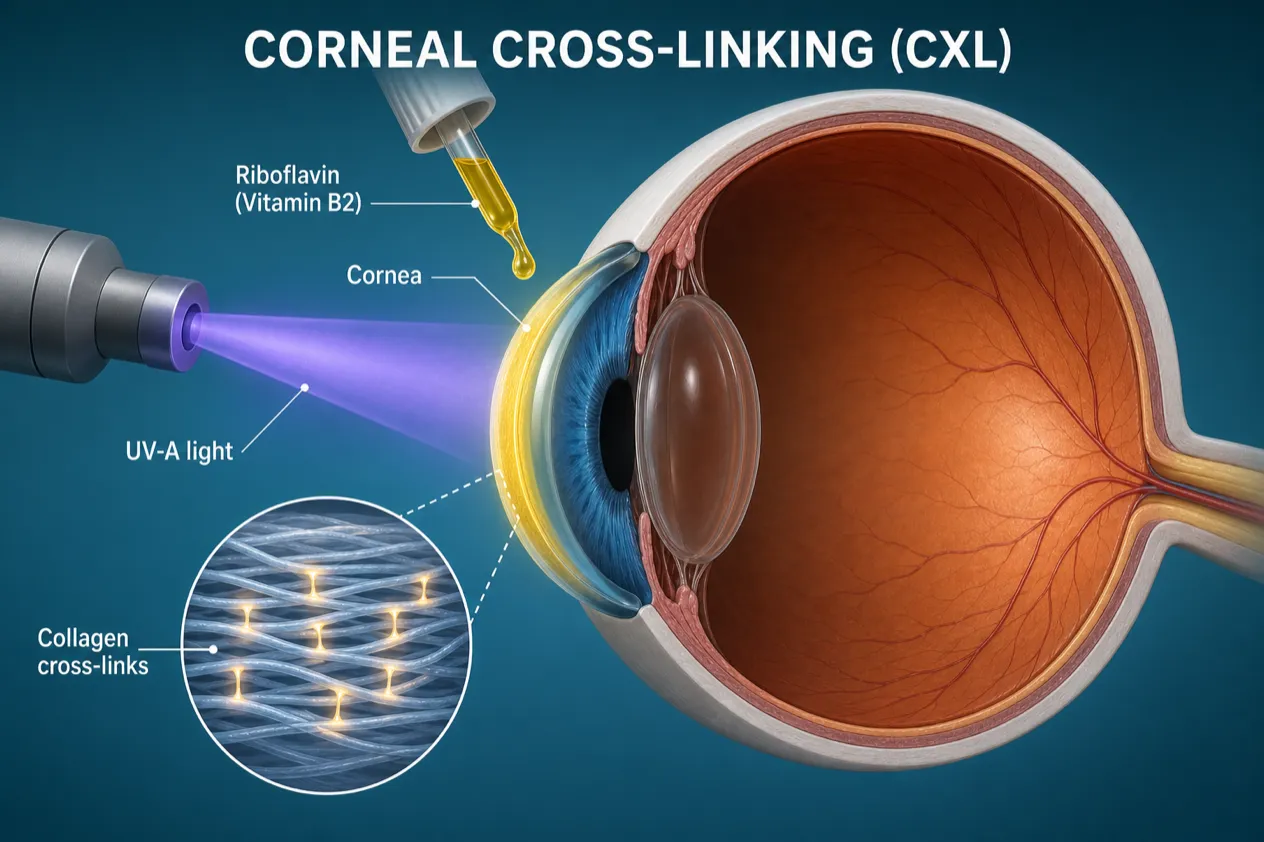
The gold standard for stopping keratoconus in its tracks. We use riboflavin (Vitamin B2) and UV light to 'stiffen' the corneal fibers. Dr. Gunn utilizes Topography-Guided CXL.
Dr. Gunn was the first surgeon to perform CAIRS in Australia. Unlike older plastic rings, CAIRS uses natural donor corneal tissue. It is more biocompatible and produces natural visual results.
Dr. Gunn co-developed this world-first planning software, which is now used by thousands of surgeons globally to map out precise, customized CAIRS procedures.
For some patients, we use a specialized laser to 'smooth out' the irregular surface of the cornea, often performed in conjunction with Cross-Linking.
We prioritize minimally invasive techniques that delay or eliminate the need for a full corneal transplant.
Every treatment is planned using high-resolution Pentacam topography to match your unique corneal anatomy.
Dr. Gunn is frequently referred patients with advanced disease who have been told they have no options left.
"Dr. David Gunn is a fellowship-trained corneal specialist who has dedicated his career to the research and treatment of keratoconus."
RANZCO Gold Medalist & first surgeon in Australia to perform CAIRS (2021)
Fellowship-Trained Corneal & Refractive Surgeon
A deep-dive diagnostic assessment using advanced corneal mapping. Dr. Gunn determines if your condition is stable or progressing to select the best treatment combination.
PENTACAM TOPOGRAPHY
Performed as day procedures under local anesthetic or twilight sedation. CXL takes 30–60 minutes. CAIRS uses a femtosecond laser and takes 15–20 minutes.
MINIMALLY INVASIVE
Most patients return to light activities in 3–4 days. Vision may fluctuate as the cornea heals. The goal of CXL is permanent stabilization; CAIRS aims to significantly improve corneal shape.
LONG-TERM STABILIZATION
Don't wait for your vision to decline further. Book a specialist keratoconus assessment with the surgeon who pioneered CAIRS in Australia.
Book Your Keratoconus Assessment
Written and reviewed by Dr David Gunn FRANZCO, FWCRS — Corneal, Cataract and Refractive Surgeon.
Last reviewed: 1 May 2026