Next Generation CAIRS Modelling and Automated Nomograms: RANZCO Queensland 2025
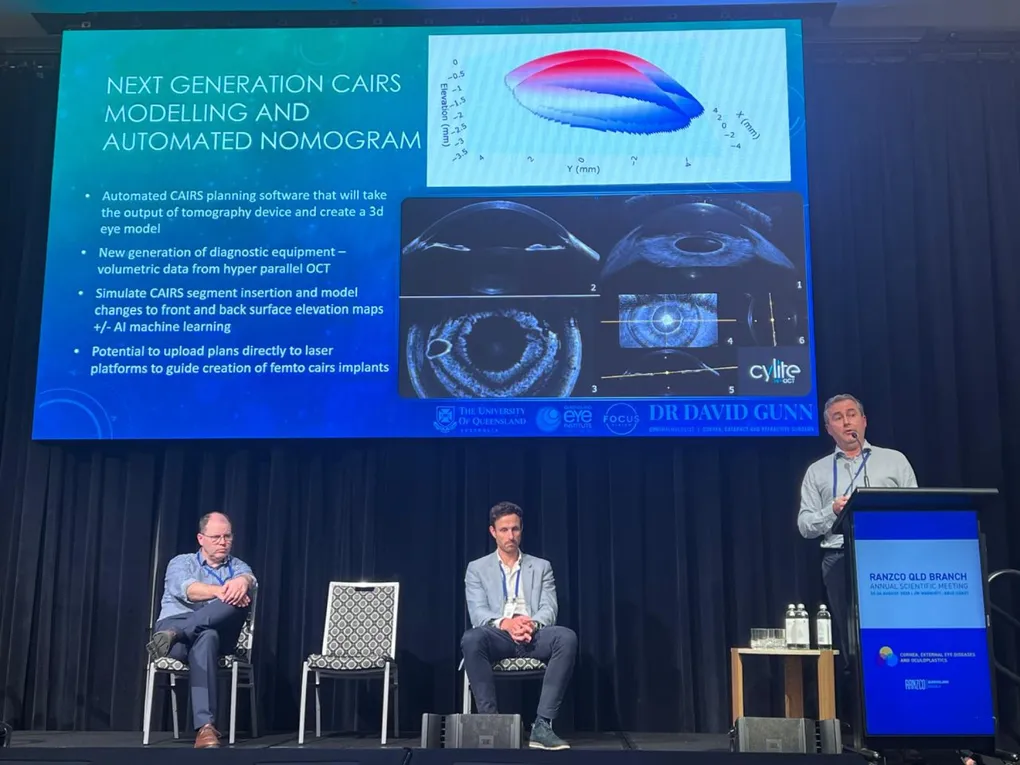
The RANZCO Queensland Branch Annual Scientific Meeting ran from 22 to 24 August 2025 at the JW Marriott Gold Coast, themed Vision for Tomorrow — Cornea, External Eye Diseases and Oculoplastics. It draws over two hundred Queensland colleagues, which makes it the meeting where the local corneal community actually argues things out.
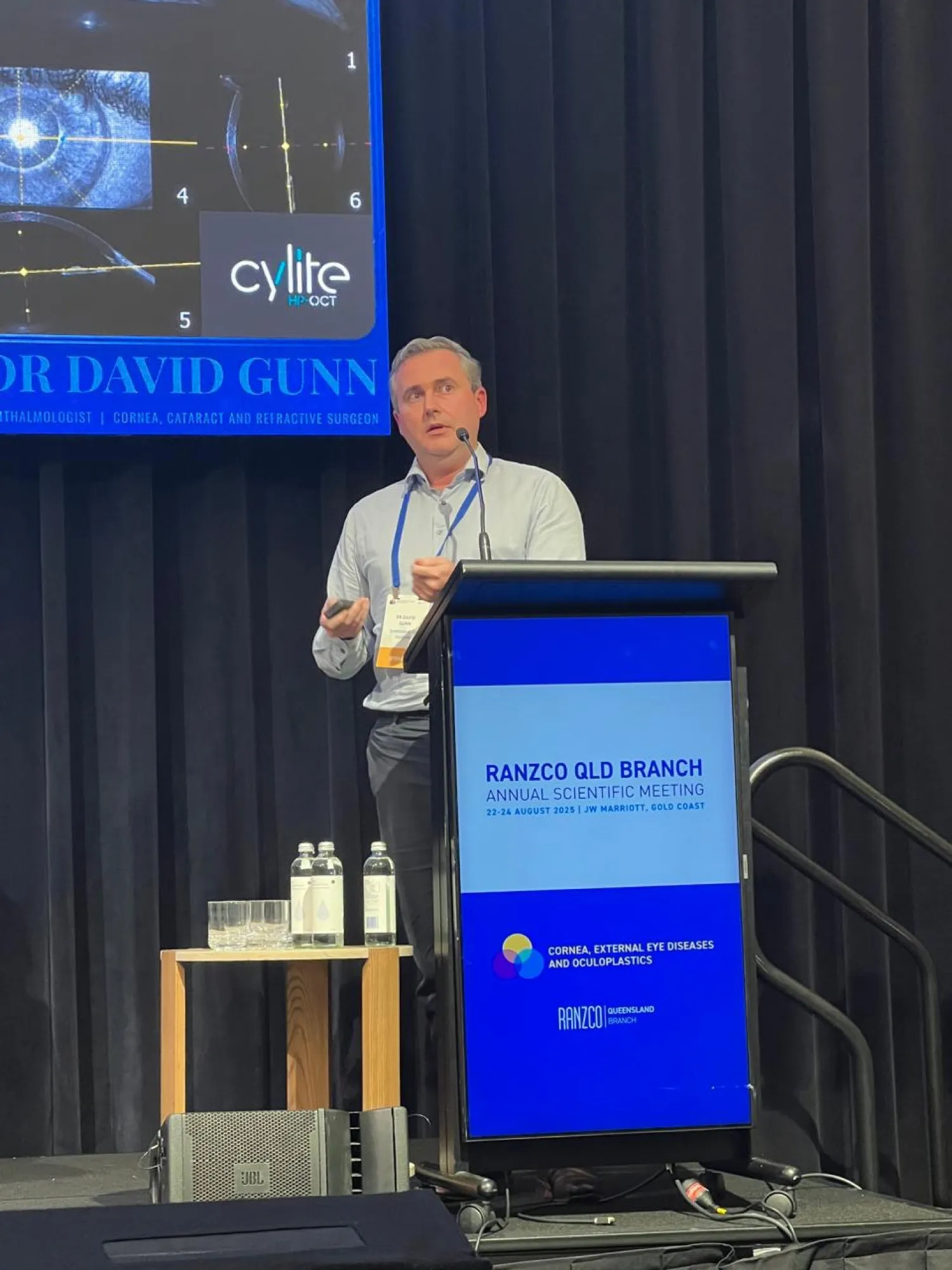
Dr David Gunn presented Next Generation CAIRS Modelling and Automated Nomogram, and took a slot in the controversies session.
The problem with expert planning
CAIRS works. That has been settled for a while. The obstacle to more patients benefiting from it is not the operation, it is the plan.
Deciding how many ring segments to use, what thickness and arc length, and where to place them in the cornea currently depends heavily on the surgeon’s judgement and case experience. An experienced surgeon plans well. A surgeon in their first year of CAIRS plans less well, and the patient carries that difference.
If a technique only works properly in the hands of people who have done a hundred cases, it will never help most of the patients who need it.
Building the plan from the eye rather than the map
The work presented on the Gold Coast takes a different route. Rather than reading a topography map and applying a rule of thumb, it starts from volumetric data captured by hyper-parallel OCT and builds a three-dimensional model of the eye.
From that model the software simulates inserting segments of a given size at a given depth and position, and predicts the resulting change in the front and back surface elevation maps. Machine learning refines those predictions against the outcomes of previous cases. The output is a plan that can be sent directly to the laser platform that creates the femtosecond channel.
The chain runs: scan the eye, model it, simulate the operation, choose the plan that gives the best predicted surface, then send it to the laser.
Automating a nomogram is unglamorous work
Nothing about automating a nomogram is exciting to watch. It matters anyway, because it is the step that decides whether a technique stays with a small group of enthusiasts or becomes something a corneal surgeon can offer safely without a decade of accumulated instinct.
It is the same reasoning behind CAIRSPlan, the free planning platform Dr Gunn and Dr Brendan Cronin built. Making the planning step repeatable is how you get the technique to patients.
The controversies session: DALK versus PTK, cross-linking versus CAIRS
The controversies format asks a speaker to defend a position properly rather than hedge, which is useful even when the truthful clinical answer is that it depends on the cone.
On deep anterior lamellar keratoplasty versus phototherapeutic keratectomy, the argument turns on how much useful cornea is left and whether scarring sits in the visual axis. On cross-linking versus CAIRS, it is not really a contest, because they do different jobs. Cross-linking stops progression, CAIRS improves shape, and a young patient with an actively progressing, badly distorted cornea often needs both.
What better planning looks like in clinic
Better planning shows up in clinic as a more specific conversation. Instead of “ring segments should flatten this cone,” it becomes a modelled prediction of what your cornea is likely to look like afterwards, and the uncertainty around that prediction stated as a range.
If you have keratoconus and have been told your options are running out, that is worth a second look. Book an assessment.
Frequently Asked Questions
What is a surgical nomogram?
What is hyper-parallel OCT?
How does artificial intelligence fit into CAIRS planning?
Is automated planning safer than manual planning?