


CAIRS in Brisbane

A tissue-preserving keratoconus treatment that reshapes the cornea using natural donor tissue instead of plastic rings — performed by Dr David Gunn, who carried out Australia's first CAIRS procedure and co-developed the CAIRSplan surgical-planning platform.

What is CAIRS?

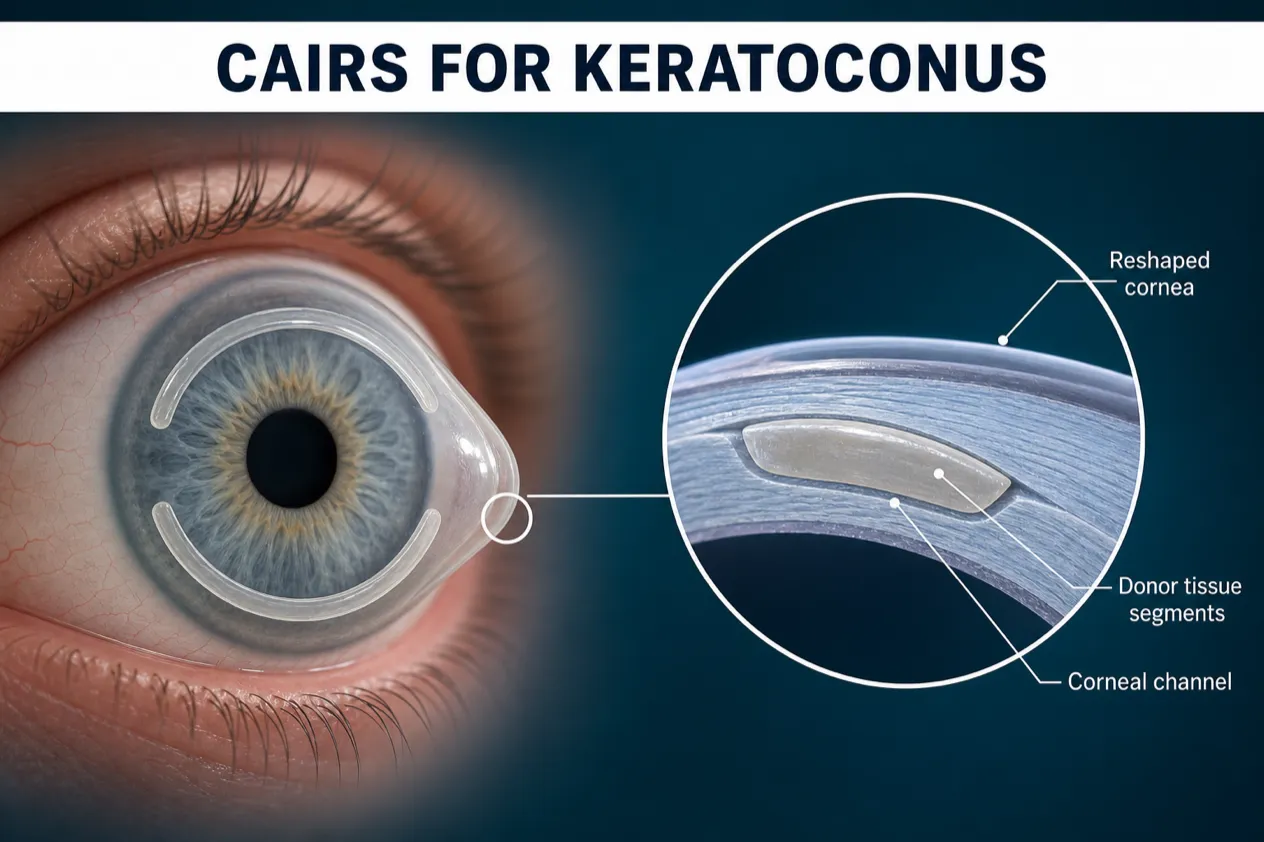
CAIRS — Corneal Allogenic Intrastromal Ring Segments — is a modern treatment for keratoconus that reshapes the cornea using natural donor tissue rather than plastic. Thin, curved segments prepared from donated human corneal tissue are placed into channels within your own cornea, where they act as a gentle scaffold to flatten the cone and make the corneal surface more regular.

Because it uses your body's own type of tissue and preserves your natural cornea, CAIRS avoids many of the problems of older plastic ring segments and can help improve the shape and optical quality of the eye. It is frequently paired with cross-linking to lock in stability.
CAIRS may be an option if you have:

  • Keratoconus affecting your vision: An irregular, cone-shaped cornea that glasses or soft lenses can no longer correct well.
  • Contact lens difficulty: Trouble tolerating or fitting rigid or scleral contact lenses.
  • A wish to improve corneal shape: Not just to stop the disease, but to make the cornea more regular and lenses more comfortable.
  • A cornea you'd like to preserve: A tissue-preserving option that may delay or avoid the need for a full corneal transplant.
CAIRS for keratoconus: curved segments of donor corneal tissue implanted in a channel within the cornea to reshape the keratoconic cone.

Why CAIRS?

CAIRS is a newer, tissue-based evolution of corneal ring surgery. Dr Gunn combines it with cross-linking where appropriate — reshaping the cornea and then stabilising it.

Dr David Gunn performed Australia's first CAIRS procedure in 2021 and co-developed CAIRSplan, a CAIRS surgical-planning platform now used by surgeons internationally. He plans every case in detail to match your individual corneal shape.

Natural Donor Tissue

CAIRS uses biocompatible human corneal tissue instead of plastic — avoiding the extrusion, thinning and foreign-body reactions that can occur with synthetic ring segments.

Reshapes the Cornea

The segments flatten and regularise the keratoconic cone to improve corneal shape and the quality of vision — going beyond simply stabilising the disease.

Planned with CAIRSplan

Dr Gunn co-developed CAIRSplan.com, which applies a published planning nomogram to your corneal map to tailor the size, thickness and position of each segment.

Tissue-Preserving

CAIRS adds tissue within your own cornea rather than replacing it, and the segments can potentially be adjusted or removed — helping delay or avoid a full corneal transplant.

Why Dr Gunn for CAIRS?

Australia's First CAIRS Surgeon

Dr Gunn performed Australia's first CAIRS procedure in 2021, at the Queensland Eye Institute / Focus Vision in Brisbane.

Co-Developer of CAIRSplan

He co-developed CAIRSplan.com, the surgical-planning platform now used by CAIRS surgeons around the world.

Published CAIRS Research

Dr Gunn has published peer-reviewed research on CAIRS, including the Brisbane femtosecond-laser CAIRS planning nomogram and CAIRS for post-LASIK ectasia.

Why Consult Dr. David Gunn?

"CAIRS lets us reshape a keratoconic cornea with the body's own type of tissue — improving its shape while keeping the patient's own cornea intact."

RANZCO Gold Medalist & first surgeon in Australia to perform CAIRS (2021)

Fellowship-Trained Corneal & Refractive Surgeon

What You Can Expect

1. Your Consultation

High-resolution Pentacam corneal mapping, with your treatment planned in CAIRSplan to tailor the size, depth and position of the segments to your cornea.

CAIRSPLAN PLANNING

2. The Procedure

A day procedure. A femtosecond laser creates a precise channel in the cornea, and the prepared donor-tissue segments are placed into it. Cross-linking is often performed at the same time to stabilise the result.

FEMTOSECOND LASER

3. Recovery & Results

Most patients return to light activities within a few days. Vision fluctuates while the cornea settles, and the shape continues to improve over the following weeks to months as it stabilises.

TISSUE-PRESERVING

CAIRS FAQs

What is CAIRS?
CAIRS stands for Corneal Allogenic Intrastromal Ring Segments. Thin, curved segments are prepared from donated human corneal tissue and gently implanted into channels created within your own cornea, where they act as a scaffold to flatten and reshape the keratoconic cone. The technique was first described by Dr Soosan Jacob and colleagues in the Journal of Refractive Surgery in 2018, and is often combined with corneal cross-linking to stabilise the result.
How is CAIRS different from plastic (synthetic) ring segments?
Traditional intracorneal ring segments are made of a clear plastic (PMMA). Because CAIRS uses your body's own type of tissue — donor cornea — it is far more biocompatible: it avoids the plastic-segment problems of the implant working its way out (extrusion), thinning or 'melting' of the overlying cornea, and foreign-body reaction. CAIRS segments can also be placed more superficially, so they can be used in some thinner or more advanced corneas where plastic rings are not suitable.
How is CAIRS different from a corneal transplant?
A corneal transplant replaces part of your cornea with donor tissue. CAIRS instead adds a small amount of donor tissue within your own cornea to reshape it, keeping your natural cornea intact. It is tissue-preserving and, because the segments sit in a channel, they can potentially be adjusted, exchanged or removed if your cornea changes over time. For many patients, CAIRS can improve corneal shape enough to delay or avoid the need for a full corneal transplant.
Will CAIRS improve my vision?
The goal of CAIRS is to make the cornea's shape more regular, which can improve the quality of vision and often makes glasses or contact lenses fit and work better. It is not a guarantee of a particular level of vision, and results vary from person to person depending on the severity and pattern of the keratoconus. Dr Gunn plans each case using the Brisbane CAIRS planning nomogram he co-authored, and will discuss what is realistic for your eyes at your consultation.
Is the donor tissue safe?
Yes. The donor corneal tissue is screened and prepared to strict eye-bank standards and has its surface cells removed before implantation. Because the implanted tissue is largely acellular corneal collagen, the risk of rejection is very low — much lower than with a full corneal transplant. As with any procedure there are risks, which Dr Gunn will go through with you.
Is CAIRS combined with cross-linking?
Often, yes. CAIRS and cross-linking do different, complementary jobs: CAIRS reshapes the cornea to improve its contour, while cross-linking stabilises it to help stop the keratoconus progressing. Dr Gunn will advise whether a combined or staged approach suits your eyes.
What does CAIRS cost?
The cost depends on your individual treatment plan and whether cross-linking is performed at the same time. Some costs may attract a Medicare or private health-fund rebate depending on your eligibility. You will receive a written quote covering all fees before booking your procedure.

Want to know if CAIRS is right for you?

If keratoconus is affecting your vision, book an assessment with the surgeon who pioneered CAIRS in Australia to find out whether it suits your eyes.

Book Your Keratoconus Assessment

Written and reviewed by Dr David Gunn FRANZCO, FWCRS — Corneal, Cataract and Refractive Surgeon.
Last reviewed: 30 July 2026