


Superior Vision
DMEK patients often achieve 20/20 vision, which was rarely possible with older full-thickness transplant methods.
Clear the fog of corneal swelling with the world's most advanced endothelial transplant techniques. Restore your morning vision and regain visual clarity with specialist DMEK surgery.
Fuchs' Endothelial Dystrophy is a progressive condition affecting the inner lining of the cornea (the endothelium). These endothelial cells act as "pumps," constantly removing fluid to keep the cornea clear. In Fuchs' Dystrophy, these cells slowly die off, causing the cornea to swell with fluid (oedema).
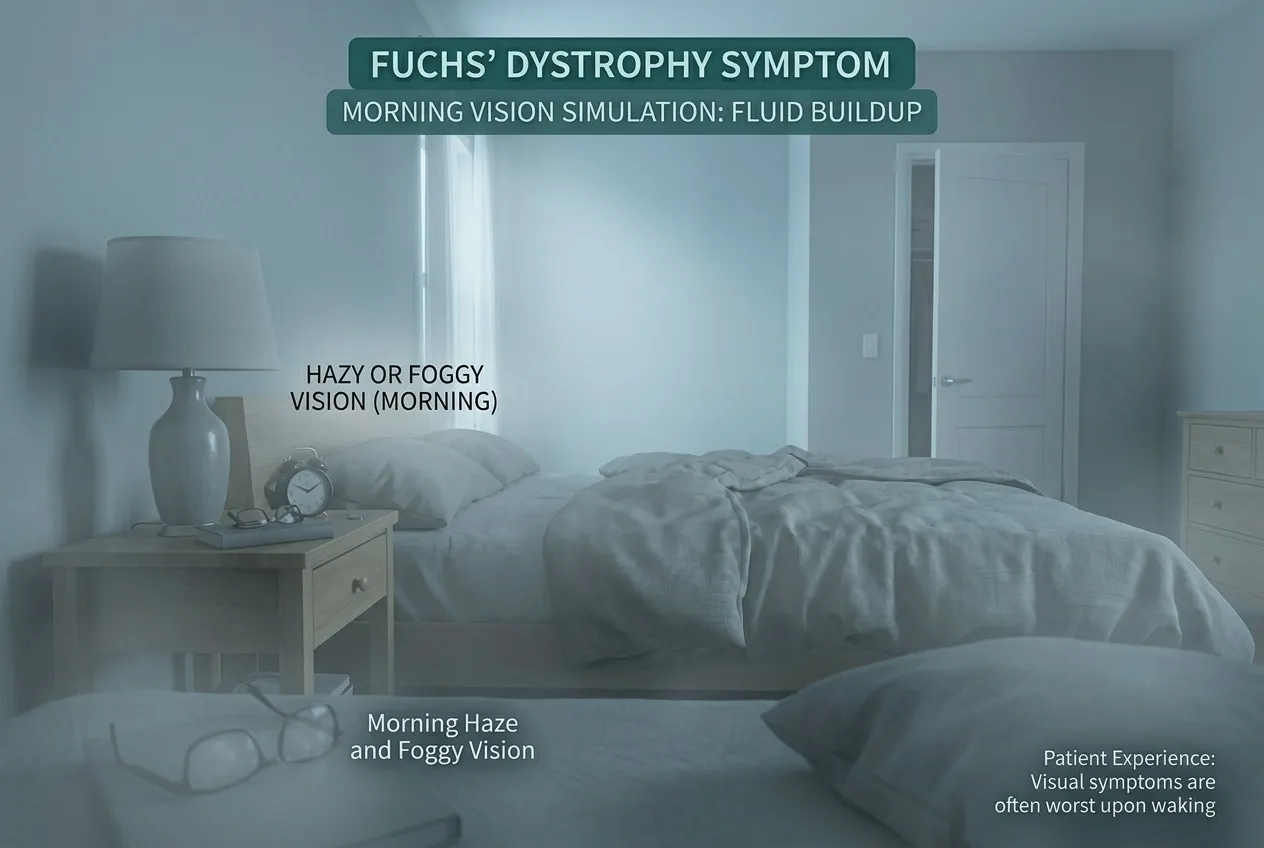
Dr. David Gunn specializes in ultra-thin, partial-thickness corneal transplants. Gone are the days of replacing the entire cornea; we now replace only the microscopic layer of diseased cells.
Descemet Membrane Endothelial Keratoplasty is the gold standard. Dr. Gunn replaces a layer only 10-15 microns thick, offering the fastest recovery and best possible visual quality.
A slightly thicker partial-thickness graft used in specific complex cases where the eye anatomy may not safely support a DMEK graft.
Since Fuchs' Dystrophy and cataracts often coexist, Dr. Gunn frequently performs a 'Triple Procedure'—removing the cataract, inserting an IOL, and performing the DMEK transplant in a single session.
DMEK patients often achieve 20/20 vision, which was rarely possible with older full-thickness transplant methods.
DMEK has the lowest rejection rate of any corneal transplant procedure (less than 1%).
Most patients see a significant improvement within 1–2 weeks, rather than the months required for full-thickness transplants.
"Dr. David Gunn is a Fellowship-trained Cornea Specialist with extensive experience in the delicate handling of DMEK grafts and complex Fuchs' cases."
RANZCO Gold Medalist & first surgeon in Australia to perform CAIRS (2021)
Fellowship-Trained Corneal & Refractive Surgeon
Fuchs' dystrophy requires delicate surgery on the innermost layer of the cornea.
As a fellowship-trained corneal sub-specialist, Dr Gunn performs DMEK and DWEK procedures regularly — techniques that require significantly more surgical skill than standard corneal transplant but offer faster recovery and better visual outcomes.
Not all cornea specialists offer these advanced techniques.
We use Specular Microscopy to count your endothelial cells and Pachymetry to measure corneal swelling. Dr. Gunn determines if surgery is needed or if salt-drops can manage it for now.
SPECULAR MICROSCOPY
DMEK is a sophisticated 45–60 minute 'keyhole' surgery under twilight sedation. A small bubble of air or gas is placed in the eye to hold the new, thin layer of cells in place.
KEYHOLE SURGERY
For the first 24–48 hours, you must lie flat on your back to allow the gas bubble to float upward and secure the graft. Vision clears rapidly as the bubble absorbs over several days.
POST-OP POSITIONING
Experiencing morning blur or glare from Fuchs' dystrophy? Dr Gunn offers the latest endothelial transplant techniques in Brisbane."
Book Your Specialist Assessment
Written and reviewed by Dr David Gunn FRANZCO, FWCRS — Corneal, Cataract and Refractive Surgeon.
Last reviewed: 1 May 2026