Transitioning to CAIRS: Precut Rings and the Brisbane Nomogram at ESCRS Copenhagen 2025
The 43rd ESCRS Congress ran from 12 to 16 September 2025 at the Bella Center in Copenhagen, with more than 16,700 participants and over 300 exhibitors from 125 countries.
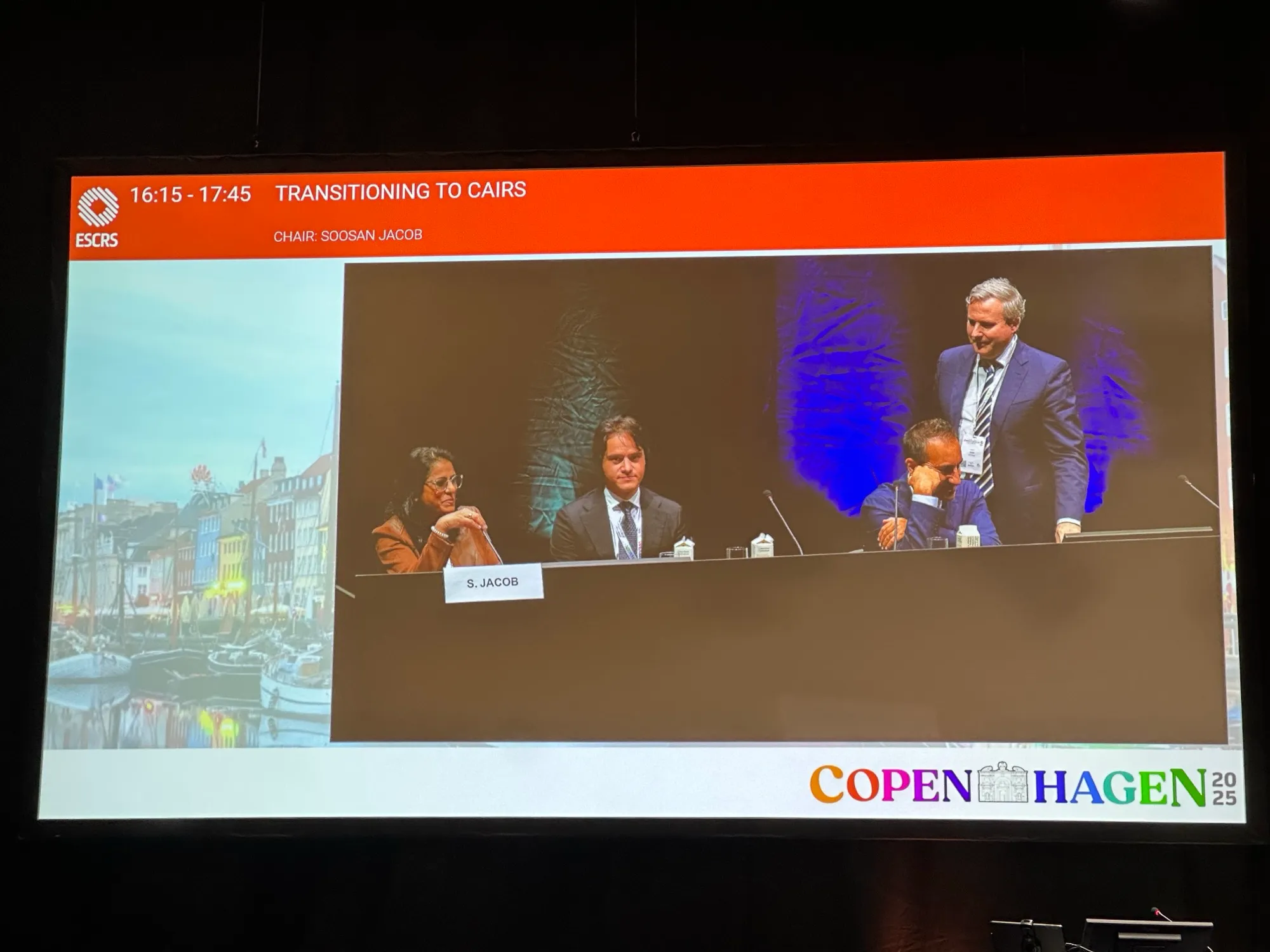
Dr David Gunn was on the faculty for the session titled Transitioning to CAIRS, chaired by Dr Soosan Jacob, who first described the technique. The session title is worth noticing. Two years earlier the equivalent session would have been called something closer to “What is CAIRS”. By 2025 the framing had moved to how surgeons already doing keratoconus surgery should change what they do.
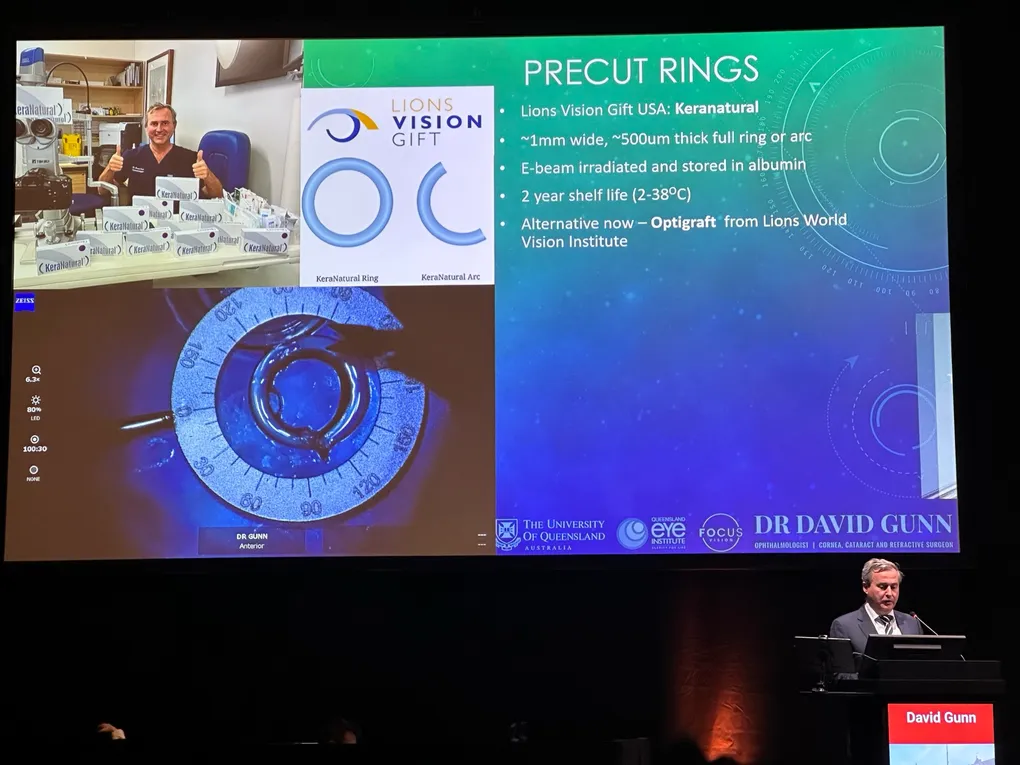
Precut rings and why availability drives everything
Much of the talk dealt with precut allogenic ring segments.
The original technique required the surgeon to cut arcs from a donor cornea during the case. It works, but it puts tissue preparation on the critical path of the operation, and any variation in the cut goes directly into the refractive result.
Precut segments arrive from the eye bank already shaped, at specified dimensions, irradiated, stored in a preservation medium and with a shelf life measured in years rather than days. Two products dominate the current supply. The practical consequence is that a centre can hold tissue and schedule a case, instead of waiting for a suitable donor cornea to become available.
For a technique that depends entirely on donated human tissue, that logistical change does more for patient access than most surgical refinements.
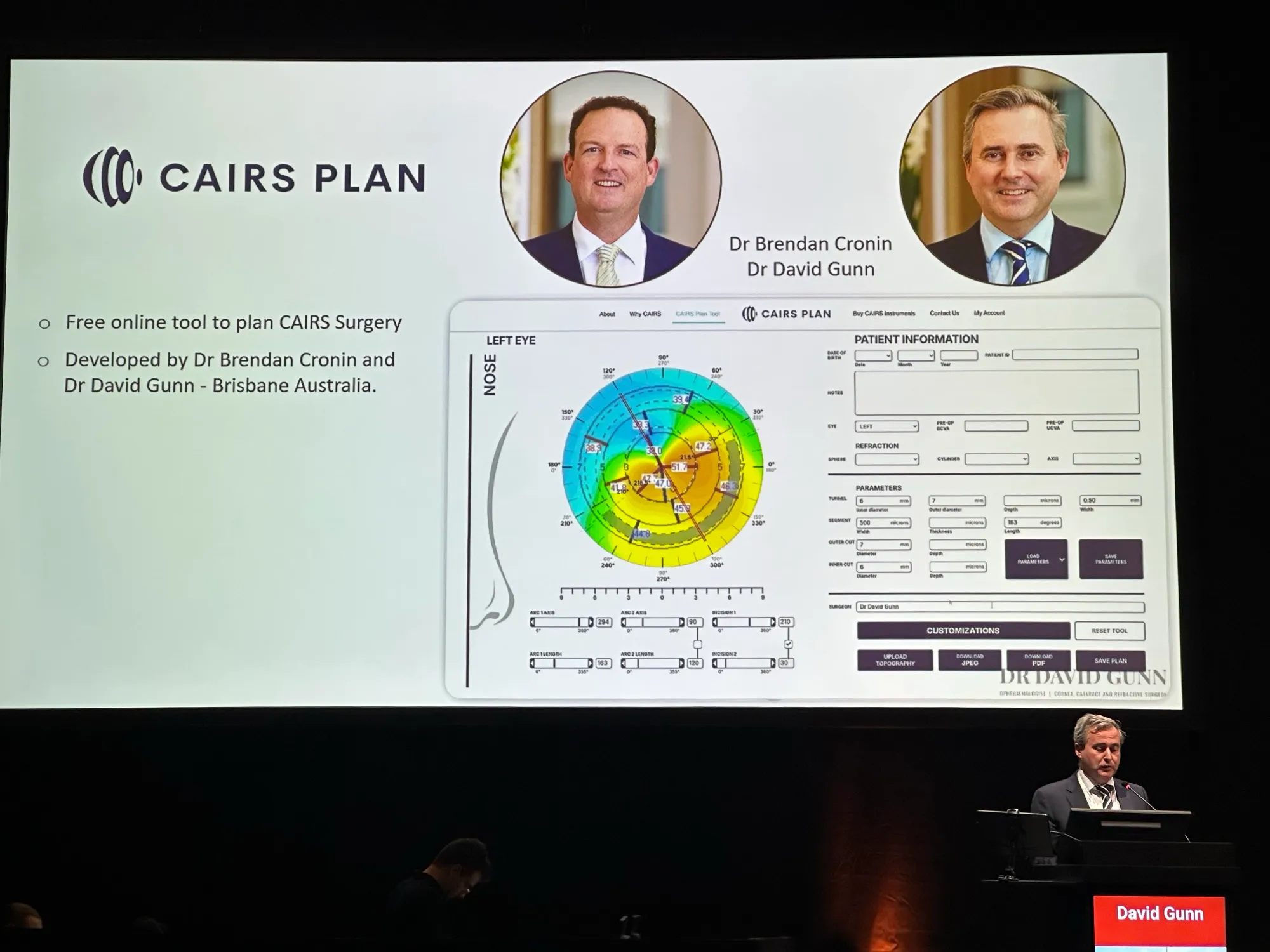
The 2025 Brisbane nomogram
The second part covered the current version of the Brisbane planning rules and the visual outcomes behind them.
A nomogram is only as good as the outcome data underneath it, and this one has been revised repeatedly as the Brisbane series has grown. The 2025 revision mostly sharpened segment selection for eyes where the cone sits away from the centre, which had been the least predictable group.
The session also covered CAIRSPlan, the free web platform Dr Gunn and Dr Brendan Cronin built so that surgeons adopting CAIRS can plan a case without needing years of accumulated case experience. It is used by surgeons across five continents, and the feedback coming back from them has improved the tool faster than the Brisbane series alone would have.
An ePoster on Femto-CAIRS for ectasia
Alongside the session, Dr Gunn presented an ePoster on femtosecond CAIRS for corneal ectasia, continuing the Barcelona work from the previous year with longer follow-up.
The size of the audience
A session on a niche corneal technique that would once have drawn a modest room now fills one. Surgeons attend sessions about operations they intend to perform, so audience size is a more reliable indicator of where keratoconus management is heading than any single set of outcomes.
Where this leaves patients in Brisbane
Patients in Brisbane have had access to this since Australia’s first case in May 2021, which means the technique here is not being introduced but refined. Precut tissue has made scheduling more straightforward, and better planning has made the predicted result a more specific conversation than it used to be.
If you have keratoconus or corneal ectasia and want to know whether CAIRS applies to your eye, book a consultation.
Frequently Asked Questions
What are precut CAIRS ring segments?
Are precut segments as safe as freshly prepared tissue?
What is the Brisbane nomogram?
What is CAIRSPlan?