Cataract Surgery in Brisbane

Restore your visual clarity and reclaim your independence. Experience the next generation of lens technology with Brisbane’s leader in premium cataract surgery.

What is a Cataract?

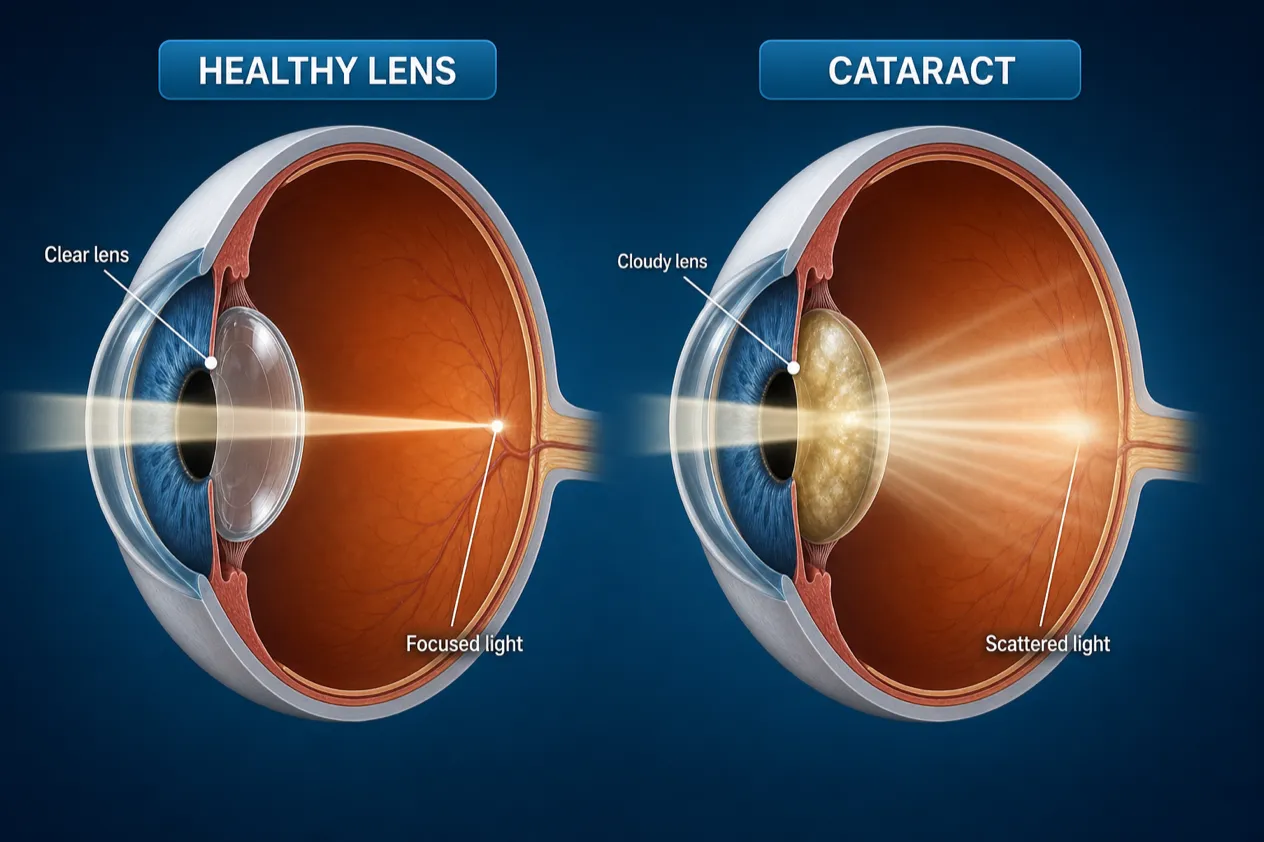
A cataract is the gradual clouding of your eye's natural lens. Over time, the proteins in your lens begin to clump together, turning a once-clear lens into a "foggy window." This is a natural part of aging, but it can also be accelerated by UV exposure, certain medications, or previous eye injuries.
Common Symptoms of Cataracts:

  • Cloudy or Blurred Vision: Feeling like you are looking through a permanent mist.
  • Glare and Halos: Seeing "starbursts" around headlights or streetlamps at night.
  • Faded Colours: Reds and blues appear dull, yellowed, or washed out.
  • Frequent Prescription Changes: Your glasses seem to lose their effectiveness quickly.
  • Difficulty Reading: Needing much brighter light to see small print.
Diagram comparing a healthy clear eye lens vs a cloudy cataract lens and scattered light rays.

How We Treat Cataracts?

Dr. David Gunn specializes in Premium Cataract Surgery. This means we don't just remove the cataract; we aim to optimize your vision for your specific lifestyle. As one of Queensland's few fellowship-trained corneal sub-specialists, Dr Gunn is uniquely qualified to perform cataract surgery on complex eyes — including patients with previous LASIK, PRK, keratoconus, or corneal transplants.

We offer the world's most advanced Intraocular Lenses (IOLs) to replace your cloudy lens.

AU FIRST

First in Australia

Dr. Gunn was the first surgeon in Australia to introduce the Rayner Galaxy IOL, a revolutionary spiral-optic lens.

Rayner Galaxy (Spiral Optics)

Uses AI-designed spiral technology to provide a continuous range of vision with significantly less glare than traditional multifocals.

Alcon PanOptix Pro

A next-generation trifocal lens designed for high-definition vision at three key distances: driving, computer, and reading.

RayOne EMV (Extended Monofocal)

Ideal for active patients wanting crisp distance and dashboard vision without the halos associated with multifocal designs.

Why Choose Premium Surgery?

Bespoke Planning

We use swept-source biometry and ray-tracing technology to calculate your lens power with pinpoint accuracy.

Astigmatism Correction

Most of our premium lenses are "Toric," meaning they correct your astigmatism at the same time as your cataract.

Visual Freedom

Our goal is to significantly reduce—or even eliminate—your dependence on glasses for daily life.

Why Consult Dr. David Gunn?

"Cataract surgery is a once-in-a-lifetime opportunity to reset your vision."

RANZCO Gold Medalist & first surgeon in Australia to perform CAIRS (2021)

Fellowship-Trained Corneal & Refractive Surgeon

Which Lens Is Right for You?

There is no single "perfect" lens. Every option is a trade-off: the wider the range of vision a lens provides, the more visual side effects (such as night-time glare) tend to come with it. The best choice depends on your eyes, your lifestyle, and how happy you are to keep wearing glasses for some tasks. Dr Gunn will recommend the option that suits you best.


A home desk seen with a monofocal lens: the window and room are sharp, while the phone and laptop screens are blurred.
Monofocal Distance clear · reading & computer blurred
The same desk seen with an EDOF lens: the window and laptop are sharp, while only the near phone is blurred.
EDOF Distance & computer clear · fine print blurred
The same desk seen with a multifocal lens: the window, laptop and phone are all in sharp focus.
Multifocal Distance, computer & reading all clear

The same room seen through each lens type — notice what comes into focus at reading, computer and distance range. Illustrative simulation; individual results vary.

  Monofocal EDOF Multifocal
Vision without glasses Distance only Distance + some intermediate Distance, intermediate & near
Reading glasses Always needed Manage menus, forms & shopping; needed for prolonged reading Around 95% glasses-free for most tasks; occasional readers
Night-time glare / halos Minimal Uncommon; much less than multifocal All see halos at first; after a year 70% no longer notice and most of the rest aren't bothered; 1–2% very bothered
Best suited to Best-quality distance; night drivers; diabetes / macular / glaucoma; pilots & artists Reducing glasses without the multifocal night trade-off Highly motivated to be glasses-free; not driving much at night
Cost if uninsured Lowest Adds cost Highest

Figures describe each lens type from clinical studies and general experience, not a guarantee — individual results vary. Dr Gunn will discuss what is realistic for your eyes.

Why Choose Dr Gunn for Cataract Surgery?

Dr Gunn is at the forefront of intraocular lens technology in Australia. He is regularly offered early access to emerging technologies by the major IOL manufacturers, and is actively involved in clinical trials advancing the next generation of IOL platforms and surgical injector delivery systems.

  • First surgeon in Queensland to implant the RayOne EMV Toric extended-depth lens
  • First surgeon in Australia to implant the Rayner Galaxy spiral-optic IOL
  • Selected for early access programmes for premium lenses including the Alcon PanOptix Pro trifocal
  • Active participant in clinical trials for next-generation IOL designs and surgical injector systems for the major manufacturers

This means Dr Gunn's patients have access to the latest lens technology — often before it becomes widely available in Australia.

What You Can Expect

1. Your Consultation

A 90-minute assessment with the latest and most precise diagnostic equipment available.

HIGH-RESOLUTION CORNEA IMAGING

2. The Procedure

A 15–20 minute routine day procedure. Performed under heavy sedation with no needles used around the eye. You will be essentially asleep for the surgery with no memory of the operating theatre.

MICRO-INCISION PHACOEMULSIFICATION

3. Recovery & Results

Immediate brightening of colours. Most vision clears in 24–48 hours. Second eye treated within 1 to 7 days.

RAPID VISUAL IMPROVEMENT

What to Expect on the Day

Cataract surgery is a day procedure — you are in and out on the same day, and you'll be with us for around three hours from arrival to going home.

Before you come in

  • Don't eat or drink for six hours before surgery (you can take your usual medications with a small sip of water).
  • Keep taking your normal tablets and puffers. You do not need to stop blood-thinning medications, though you may bruise or redden a little more.
  • Arrange a carer to take you home — you can't drive after sedation, and you shouldn't be alone the first night.

On the day

  • After check-in, a nurse reviews your history and consent, and dilating drops go in.
  • A small cannula in your hand delivers sedation to make you very relaxed and sleepy, then a numbing gel drop makes the eye completely numb — no needles around the eye.
  • The surgery itself takes around 20 minutes. You'll be heavily sedated — most people remember nothing and don't recall the theatre at all. (Yes, it's Dr Gunn performing your surgery.)
  • Afterwards you rest in recovery with a drink and a snack, have a same-day check with Dr Gunn's optometrist, and go home.

One eye or two? Most people have one eye treated on a Thursday and the second on the Friday. Separating the operations by at least a day reduces the small risk of cross-infection while keeping your recovery convenient — and if anything about the first eye needs watching, the second can easily be delayed.

Your Recovery

Every eye is different — recovery in one eye can be quite different from the other, and that's completely normal. Most people notice brighter, clearer vision within a day or two, though for some it takes a couple of weeks to settle.

The first days

  • Wear the plastic shield at night for three nights so you don't rub the eye in your sleep.
  • A scratchy, watery eye and mild discomfort are normal as the anaesthetic wears off — paracetamol helps, and so does rest.
  • The eye may look white or quite red; a small bleed on the surface (subconjunctival haemorrhage) looks dramatic but is harmless and fades over a week or two.
  • A flickering light in your peripheral vision for a few weeks is common and settles on its own.

Over the following weeks

  • Dry eye is very common and usually lasts 4–12 weeks — use your lubricating drops (often three times a day for three months).
  • Driving is usually fine once your vision is clear and the eye is comfortable — usually within a couple of days — but never the day straight after surgery.
  • New glasses: wait about 5–6 weeks before seeing your optometrist. Cheap pharmacy readers (+2.00 / +3.00) are fine as a short-term measure only.

When can I get back to normal?

ActivityResume after
Flying · drinking alcohol1 day
Driving (once vision is clear)2–3 days
Showering, gentle exercise, most daily activities3 days
Gym, jogging, cycling, golf, tennis, pilates, yoga1 week
Eye make-up1 week
Horse riding, skiing, sailing2 weeks
Swimming, surfing, scuba diving4 weeks
Contact sports (rugby, soccer, boxing), sauna, steam room4 weeks
New prescription glasses5–6 weeks

Does the cataract grow back? No — once removed, a cataract can never return. The natural capsule that holds your new lens can become cloudy over the following months in some people; if it does, it's cleared with a quick, painless in-clinic laser treatment (a YAG capsulotomy), usually only ever needed once per eye.

Cataract Surgery FAQs

Is cataract surgery permanent?
Yes. Once your natural lens is replaced with an IOL, a cataract can never return. The lens is designed to last a lifetime.
How much does cataract surgery cost in Brisbane?
The cost of cataract surgery depends on the type of intraocular lens selected. Standard monofocal lenses are covered by Medicare and private health insurance. Premium multifocal and toric lenses involve an out-of-pocket gap. We provide a transparent, itemised quote at your consultation with no hidden fees. Interest-free payment plans are available.
Does Medicare cover cataract surgery?
Medicare and private health insurance contribute to the cost of surgery which varies depending on whether you choose a basic single focus lens or a premium EDOF or multifocal lens. You will receive a full quotation for your choice on the day of your consultation.
Will I still need glasses?
This depends on the lens you choose. Standard monofocal lenses usually require reading glasses. Premium lenses (like the Galaxy or PanOptix Pro) are designed to provide freedom from glasses for the vast majority of daily tasks.
Is cataract surgery painful?
No. Dr Gunn offers cataract surgery with heavy sedation so you will be essentially asleep. Most patients experience no discomfort whatsoever and find they were completely unaware of the procedure occurring.
Can I have both eyes treated on the same day?
Currently, private health insurance does not cover surgery on both eyes on the same day. The rebate given for the second eye is significantly less, which increases costs to the patient significantly. Dr Gunn is happy to offer surgery on sequential days — such as a Thursday then a Friday — to minimise your downtime and make it easy for your carer. If you do not have insurance coverage for cataract surgery, then performing the procedures on the same day is a very similar cost and many patients choose this option. Same-day surgery is becoming increasingly popular due to the convenience and safety of modern cataract surgery.
What is the recovery time for cataract surgery?
Most patients notice brighter colours and clearer vision within 24 hours. You can return to light activities the next day. Full visual stabilisation occurs over 2–4 weeks. Dr Gunn typically operates on the second eye within 1–7 days of the first.
How much time do I need off work?
This depends on what you do. Most patients are driving within a few days. For office-type work, a few days off is usually enough. For very dirty or physical work, 10–12 days is a good break. In general, Dr Gunn recommends patients plan to take a week off.
I don't live in Australia. Can I still see Dr Gunn for treatment?
Absolutely. Dr Gunn sees many international patients, so as a visitor to Australia you can still access the latest techniques and intraocular lens technology that is available. Contact the team at Focus Vision who can provide you information about expected fees and the process for travelling to Brisbane for your care. We can provide information about nearby accommodation, travel details, and also your treatment and all post-operative medication and follow-up schedule.

Ready to see clearly again?

Don't let cataracts limit your life. Book a consultation to discover your premium lens options.

Book Your Suitability Assessment

Written and reviewed by Dr David Gunn FRANZCO, FWCRS — Corneal, Cataract and Refractive Surgeon.
Last reviewed: 1 May 2026