Asia-Pacific's First Heads-Up 3D LASIK Performed in Brisbane
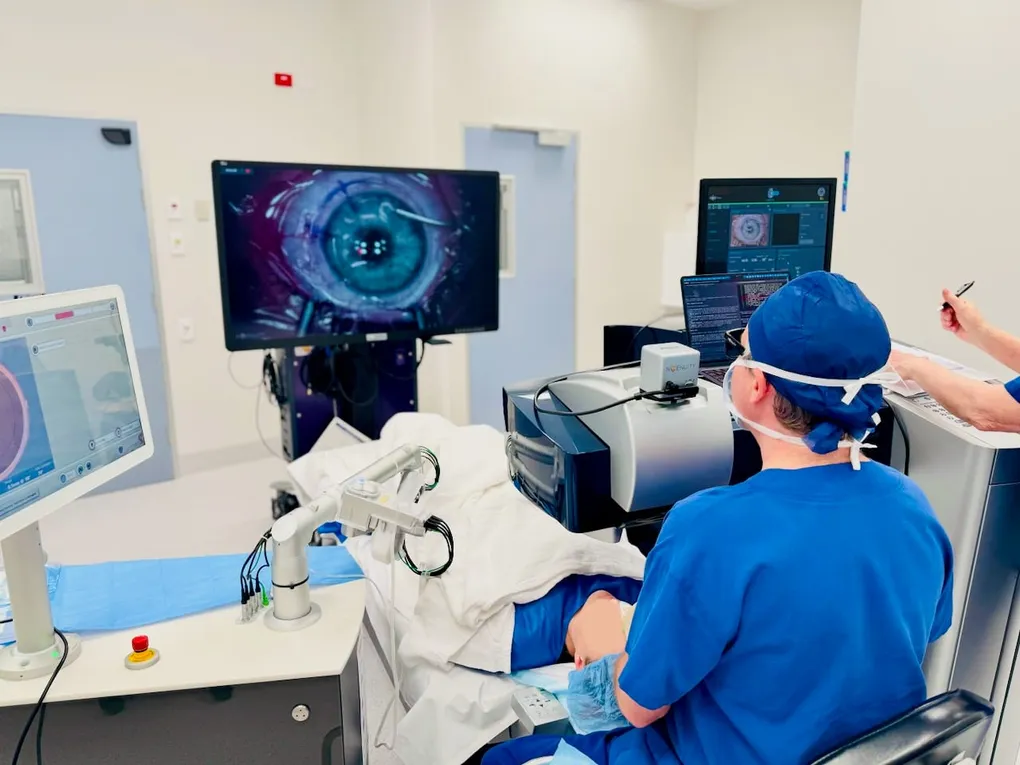
A Brisbane ophthalmologist has performed the Asia-Pacific region’s first fully heads-up, three-dimensional LASIK. In July 2026, Dr David Gunn completed the case at the South Brisbane Day Hospital using Alcon’s NGENUITY 3D Visualization System with the WaveLight EX500 excimer laser, carrying out the entire operation while viewing a stereoscopic 3D screen rather than looking through the operating microscope.
Every step, from creating the femtosecond corneal flap to the excimer laser treatment, was performed heads-up. The Alcon team that supports the WaveLight EX500 confirmed it as the first heads-up 3D LASIK performed in the region.
The procedure combined two Alcon platforms: the NGENUITY 3D Visualization System, a digital heads-up display more commonly used in retinal surgery, and the WaveLight EX500 excimer laser used for laser vision correction. Coupling the two allowed the entire refractive procedure to be carried out and observed in three dimensions.
How heads-up 3D surgery works
In conventional laser eye surgery, the surgeon leans over the patient and looks down through the eyepieces of an operating microscope. A heads-up system replaces that view. A high-sensitivity 3D camera captures a magnified, stereoscopic image of the eye and projects it onto a large medical display. The surgeon and the theatre team wear passive 3D glasses and operate while watching the screen.
The NGENUITY system was first developed for vitreoretinal surgery inside the eye, and its use in refractive procedures such as LASIK is a more recent development. The excimer treatment itself was performed on the WaveLight EX500, which ablates the cornea at 500 pulses per second and uses an eye tracker running at more than a thousand cycles per second to follow small eye movements during treatment. Registration of the topography-guided plan was carried out using the WaveLight Topolyzer, which maps the cornea and matches it to the eye to align the treatment.
Reported advantages of the 3D approach
The benefits of heads-up 3D visualisation relate to how the surgery is seen and performed, and to patient comfort during the procedure, rather than to the refractive outcome, which is unchanged.
The most immediate for the surgeon is stereoscopic detail. A large three-dimensional display presents depth and tissue planes more clearly than the view through the eyepieces. A second is ergonomic: musculoskeletal strain in the neck, back and shoulders is a well-documented problem among ophthalmic surgeons, driven largely by the forward-leaning posture required at a microscope, and operating heads-up allows the surgeon to sit upright in a neutral position. Because the whole team views the same stereoscopic image, everyone in theatre sees exactly what the surgeon sees, which supports training and coordination.
The advantage most relevant to patients comes from light. The NGENUITY camera is highly sensitive, so much of the procedure can be carried out under markedly lower theatre illumination than a conventional microscope requires. For the person on the table, that means less bright light directed into the eye. A dimmer field is more comfortable during the procedure, and it can make it easier to hold a steady gaze on the fixation target, which helps with the topography-guided alignment that guides the laser.
“The stereoscopic detail is remarkable, the ergonomics are far better, and everyone in theatre sees exactly what the surgeon sees,” Dr Gunn said, noting that it was the first time the theatre staff and the local Alcon team had watched a LASIK case in stereoscopic 3D.
“The camera is so light-sensitive that much of the procedure can be done with room lights only,” he said. “That means better patient comfort and compliance, and easier fixation.”
A new way to view a proven procedure
Heads-up 3D changes the visualisation of LASIK, not the treatment itself. The corneal reshaping is delivered by the same excimer laser, to the same plan, as a conventional case.
Early peer-reviewed evidence supports the approach. A 2026 study from the Rothschild Foundation in Paris, led by Professor Damien Gatinel and published in the Journal of Cataract & Refractive Surgery, compared heads-up 3D LASIK against the conventional microscope across 193 eyes. It found the technique safe and feasible, with outcomes comparable to standard surgery and an early learning curve that resolved with experience. The heads-up method is therefore best understood as a visualisation and ergonomic advance layered on an established, well-studied operation, rather than a change to the refractive result.
Context
Dr Gunn is a corneal, cataract and refractive surgeon at Focus Vision and the Queensland Eye Institute, and was the first surgeon in Australia to perform the CLEAR lenticule-extraction procedure. The Brisbane case adds heads-up 3D visualisation to a refractive practice that offers the current range of laser vision correction techniques, including LASIK, Trans-PRK and CLEAR.
Whether heads-up 3D visualisation becomes routine in refractive surgery will depend on wider adoption and longer-term data. For now, its arrival in an Australian theatre marks an early regional step for a technology already established elsewhere in ophthalmology.
Disclosure: Dr Gunn works with Alcon as a key opinion leader in refractive surgery. The systems described here, the NGENUITY 3D display and the WaveLight EX500 laser, are manufactured by Alcon, whose local team supported the case in theatre.
References
- Theuriau A, Partouche S, Gatinel D, Panthier C. Digital 3D heads-up LASIK surgery: feasibility, surgical duration, complication rates, and comparison with a conventional microscope. J Cataract Refract Surg. 2026;52(2):168-172. https://pubmed.ncbi.nlm.nih.gov/40896826/
- Alcon. NGENUITY 3D Visualization System. https://www.myalcon.com/professional/cataract-surgery/surgical-equipment/ngenuity-3d-system/
- Alcon. WaveLight EX500 Excimer Laser. https://www.myalcon.com/professional/refractive/wavelight-ex500-excimer-laser/
- Matsumoto CS, et al. Heads-up 3D surgery under low light intensity conditions: a new high-sensitivity HD camera for ophthalmological microscopes. https://pmc.ncbi.nlm.nih.gov/articles/PMC6899266/
- Optimization of surgeon ergonomics with three-dimensional heads-up display for ophthalmic surgeries. https://pmc.ncbi.nlm.nih.gov/articles/PMC9114587/
Frequently Asked Questions
What is heads-up 3D LASIK?
Is heads-up 3D LASIK safe?
Does 3D visualisation change the LASIK result?
Who performed the first heads-up 3D LASIK in the Asia-Pacific?
What equipment was used for the procedure?