Dr David Gunn in EyeWorld Asia-Pacific: CAIRS and the Move From Replacing the Cornea to Remodelling It
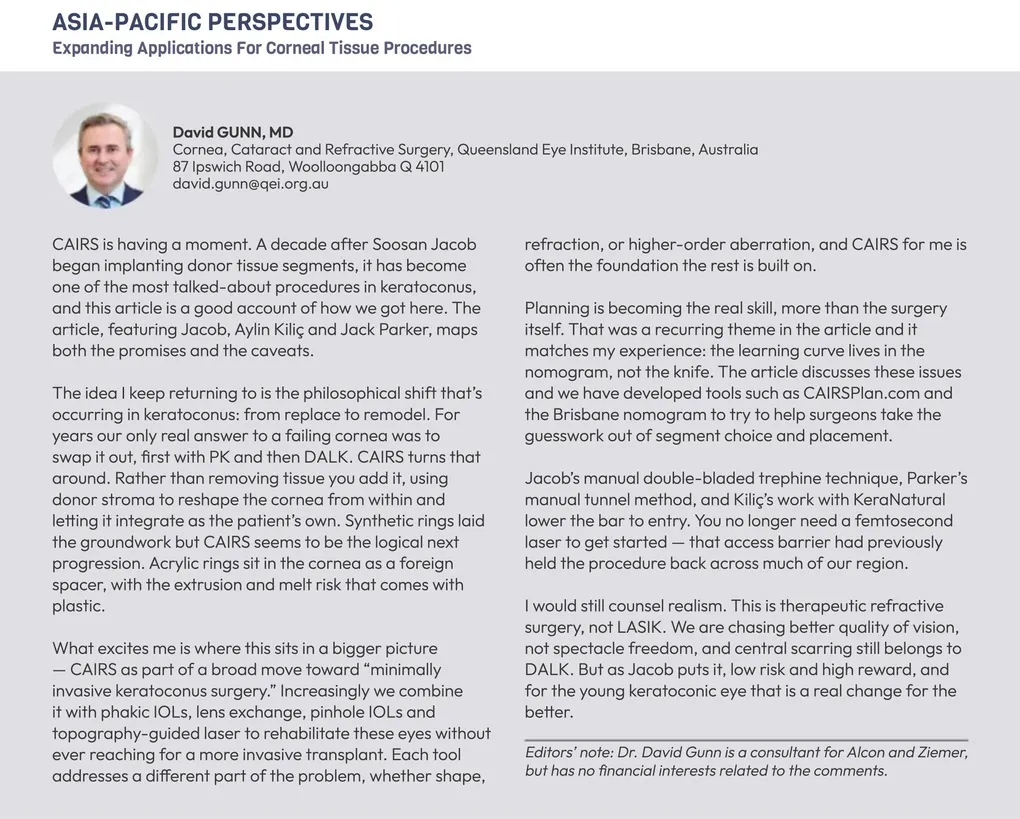
EyeWorld Asia-Pacific, the magazine of the Asia-Pacific Association of Cataract and Refractive Surgeons (APACRS), invited Dr David Gunn to write the regional commentary for its September 2026 feature on corneal tissue procedures for keratoconus. The commentary is reproduced above as it was printed on page 51, under the heading Asia-Pacific Perspectives.
The feature it responds to, Expanding Applications for Corneal Tissue Procedures by Ellen Stodola, first ran in the June 2026 issue of EyeWorld, the magazine of the American Society of Cataract and Refractive Surgery. It interviews Dr Soosan Jacob of Chennai, Dr Aylin Kılıç of Istanbul and Dr Jack Parker of Alabama.
The commentary was written for surgeons. The sections below explain each of its points for patients.
What CAIRS and CTAK are
Both operations treat keratoconus by adding donor corneal tissue to the patient’s own cornea.
CAIRS, corneal allogenic intrastromal ring segments, places curved segments of donor cornea in a channel around the cone. The segments flatten the cone and make the surface of the cornea more regular. Dr Jacob began implanting them around 2015 and published the technique in 2018.
CTAK, corneal tissue addition keratoplasty, uses a piece of preserved donor tissue that a femtosecond laser shapes for the individual cornea. It was described in the Journal of Cataract & Refractive Surgery in 2023.
Dr Gunn performed the first CAIRS procedure in Australia in 2021, and his commentary concentrates on that operation.
From corneal transplant to tissue addition
For decades the only surgical answer to a failing keratoconic cornea was to replace it. The first operation was the full-thickness corneal transplant, penetrating keratoplasty. The second was DALK, deep anterior lamellar keratoplasty, which keeps the patient’s own inner layer.
Dr Gunn writes that CAIRS reverses that logic. Nothing is removed. Donor stroma is added inside the cornea, reshapes it from within and integrates with the patient’s own tissue.
He credits synthetic ring segments such as Intacs with laying the groundwork. An acrylic ring stays in the cornea as a foreign body, with the risk of extrusion and corneal melt that comes with plastic. Donor tissue is not a foreign material.
CAIRS combined with other keratoconus surgery
CAIRS is rarely the whole plan. The commentary lists the procedures Dr Gunn combines with it:
- implantable contact lenses (phakic intraocular lenses) for the short-sightedness and astigmatism that remain
- lens exchange in older patients
- pinhole intraocular lenses, which narrow the light entering an irregular cornea
- topography-guided laser to smooth what the segments leave behind
Corneal cross-linking is the separate step that stops keratoconus from progressing, and is often done with CAIRS or after it.
In Dr Gunn’s practice CAIRS is usually the first stage, and the later procedures are planned on the cornea it produces. The aim is to rehabilitate the eye without it ever needing a transplant.
Planning with the Brisbane nomogram and CAIRSPlan
The feature returns several times to how hard it is to choose a segment. Dr Gunn agrees. In his words, “the learning curve lives in the nomogram, not the knife.”
A nomogram is the table that turns a corneal scan into a segment size and position. Dr Gunn published the Brisbane nomogram in Clinical & Experimental Ophthalmology in 2026 with a validation series of 85 eyes of 75 patients, in which 43.7% of eyes gained five or more lines of uncorrected distance vision.
CAIRSPlan, the free planning tool he co-developed with Dr Brendan Cronin, applies the nomogram to a surgeon’s own scans. About 380 surgeons were using it in September 2026.
CAIRS without a femtosecond laser
Dr Gunn performs CAIRS with a femtosecond laser. The laser cuts the channel in the patient’s cornea and cuts the segment from the donor cornea, so the segment goes in with known dimensions.
Not every surgeon has that laser. He writes that the need for one had held the procedure back across much of the Asia-Pacific. The three surgeons interviewed have each removed part of the barrier: Dr Jacob with a double-bladed trephine that cuts the segment by hand, Dr Parker with a manual technique for making the channel, and Dr Kılıç through her work with KeraNatural donor segments.
Who CAIRS suits, and who still needs a transplant
The surgeons in the feature describe the best candidates as people with keratoconus or ectasia after laser eye surgery whose cornea needs reshaping but is still clear and thick enough for a channel. Vision that stays poor in glasses, and contact lenses that can no longer be tolerated, are the usual reasons to consider it.
Dr Gunn’s commentary ends on the limits. CAIRS is therapeutic surgery, done to give a distorted cornea better quality of vision. Most patients still wear glasses or contact lenses afterwards. An eye with a scar in the centre of the cornea still needs DALK, because reshaping does not clear a scar.
For a young person with keratoconus and a clear cornea, he agrees with Dr Jacob’s summary of the operation as low in risk and high in reward.
Disclosure
The magazine’s editors note that Dr Gunn is a consultant for Alcon and Ziemer and has no financial interest related to his comments.
Reading the issue and booking an assessment
The September 2026 issue is free to read at EyeWorld Asia-Pacific. The feature starts on page 46 and the commentary is on page 51.
If you have keratoconus and want to know whether CAIRS suits your cornea, book an assessment. Patients from outside Queensland can read about travelling to Brisbane for eye surgery.
Frequently Asked Questions
What is CAIRS for keratoconus?
What is the difference between CAIRS and CTAK?
Is CAIRS a corneal transplant?
Does CAIRS need a femtosecond laser?
Will CAIRS get rid of glasses or contact lenses?
When is a corneal transplant still needed for keratoconus?
Where can the EyeWorld Asia-Pacific commentary be read?