Teaching the CAIRS Instructional Course at ESCRS Vienna 2023
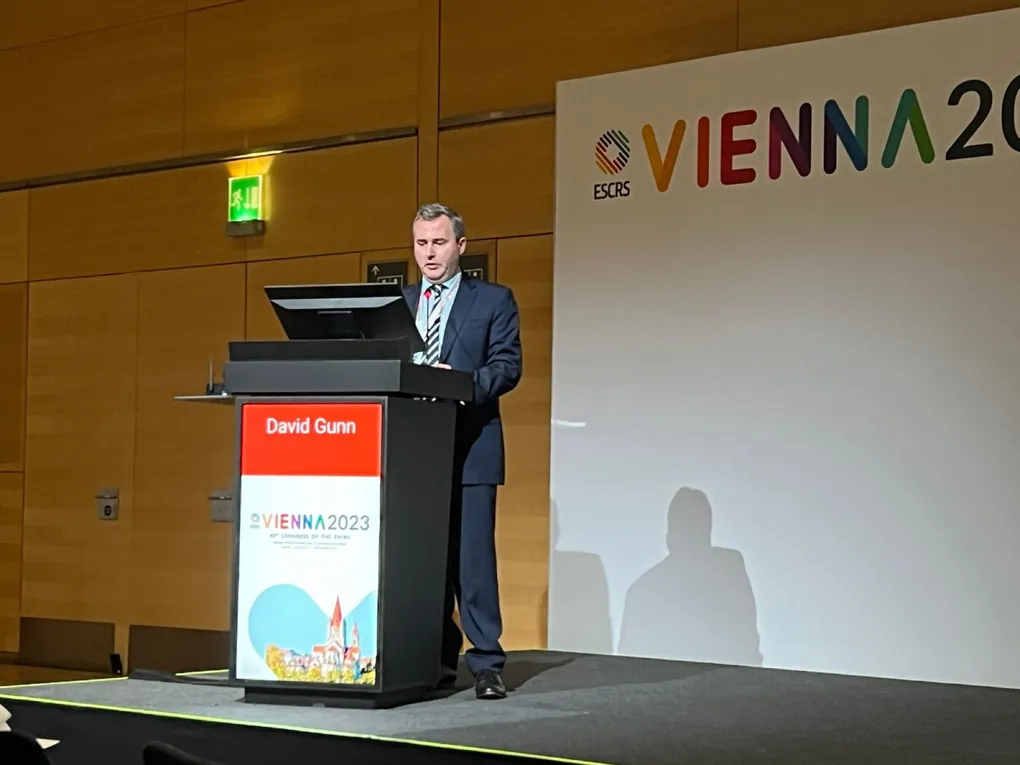
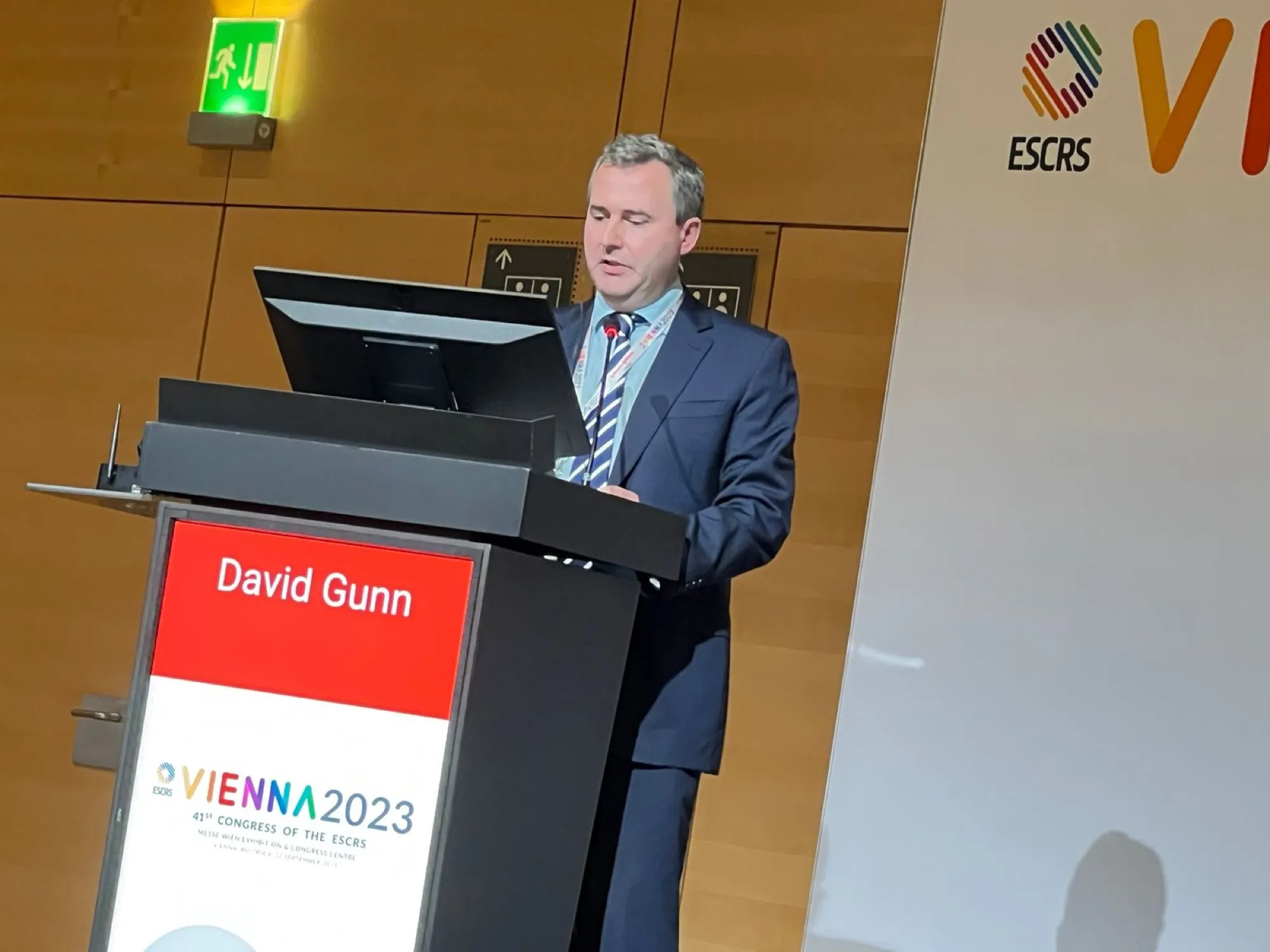
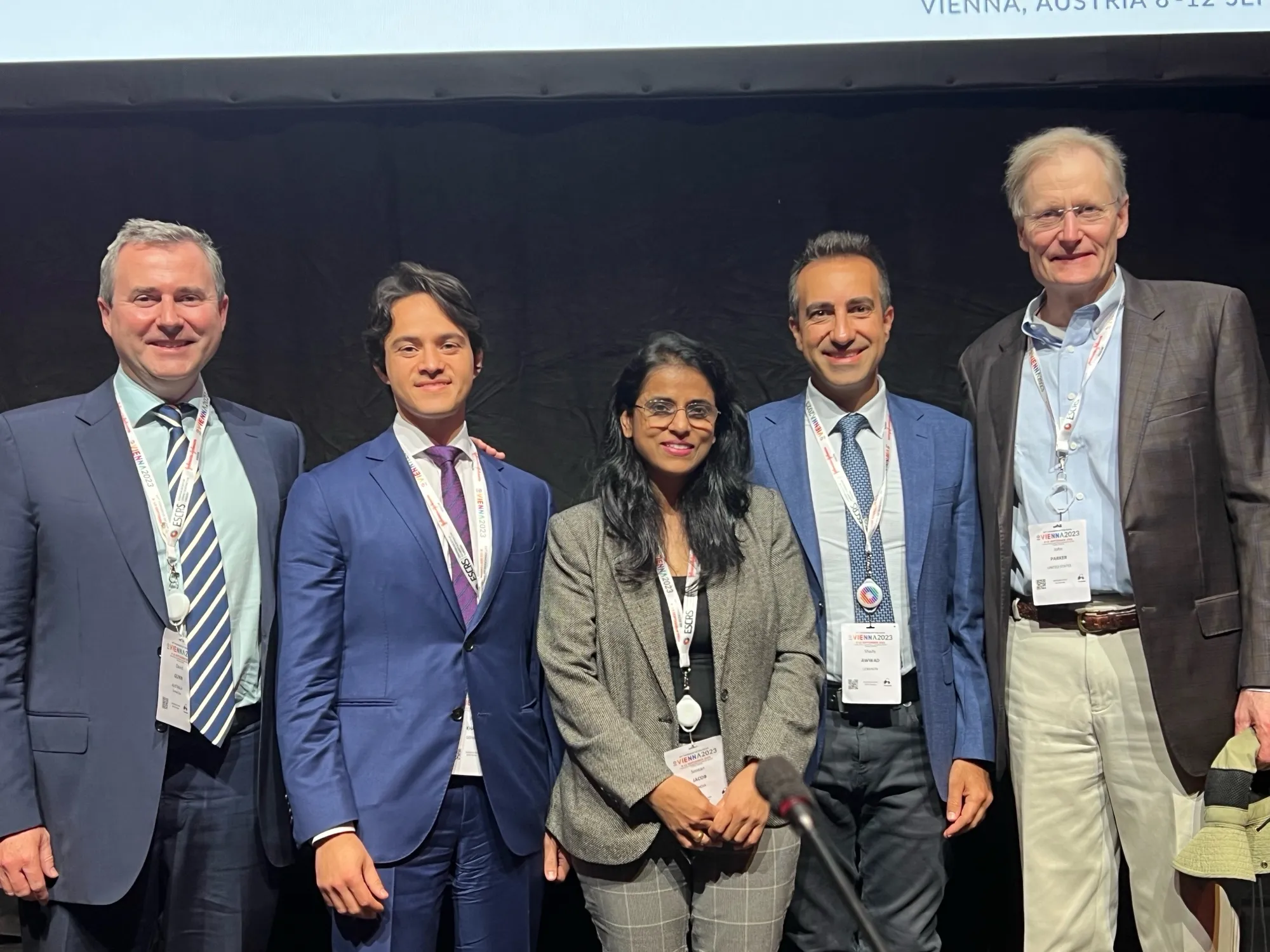
The 41st ESCRS Congress ran from 8 to 12 September 2023 at the Messe Wien Exhibition and Congress Centre. Dr David Gunn was on the faculty of the instructional course on CAIRS and presented the Brisbane work on femtosecond-cut segments.
An instructional course is a different signal from an abstract
ESCRS instructional courses are proposed by surgeons and selected by the society’s scientific committee. They are teaching sessions, not sponsored talks, and the audience is made up of surgeons who intend to go home and do the operation.
That distinction is worth spelling out, because the progress of a new technique is easy to misread from the outside. A first case report gets attention. A prize-winning abstract gets attention. Neither means the technique has arrived. What signals arrival is a teaching slot at the main European congress, with a room of corneal surgeons taking notes on channel depth and segment sizing.
Two and a half years after Australia’s first CAIRS case in Brisbane, that was where the technique had reached.
Femto-cut segments
The Brisbane contribution to the course was on preparing the segments themselves with a femtosecond laser.
In the original technique, the surgeon cuts arcs of donor corneal tissue by hand using a trephine and a punch. It works, and it is how the first cases everywhere were done, including the Brisbane cases. The difficulty is consistency. Segment thickness and arc length affect how much the cone flattens, so hand-cut variation goes straight into the refractive result.
Laser preparation removes most of that variation. It also makes the planning conversation different. Once segment dimensions are reliable, you can build a nomogram that links cone shape to segment specification, and once you have a nomogram you can teach someone else to plan a case without them having done fifty first.
The questions from the floor
The most useful part of any instructional course is the last fifteen minutes. In Vienna the questions were almost entirely practical: what to do with an inferior cone that sits close to the visual axis, how to handle a cornea that has already been cross-linked, when to combine segments with surface laser, and how tissue supply works outside Europe.
That last one is the recurring obstacle. CAIRS depends on donated corneal tissue, and eye banking arrangements differ enormously between countries. A technique that is straightforward in Brisbane can be impossible in a centre that cannot reliably source tissue, and no amount of surgical refinement fixes that.
For patients in Brisbane
If you have keratoconus that has progressed past the point where glasses or soft lenses help, CAIRS is one of the options worth assessing. It does not suit every cornea, and for some patients cross-linking with topography-guided laser is the better plan, while advanced scarring still calls for a corneal transplant.
Working out which of those applies to your eye takes a tomography scan and a proper conversation. You can arrange that here.
Frequently Asked Questions
What is an ESCRS instructional course?
What does femto-cut CAIRS mean?
Is CAIRS a corneal transplant?
How does CAIRS compare with plastic ring segments?